
2013 - 4 Issue

Original article

Anterior Uveitis Caused by Electrical Discharge in Whole Body Injuries (Fifteen-Year Study)

Full Text links

Summary

Aim: To inform about clinical analysis of early ophthalmologic complication (uveitis) in patients sustained electric discharge injury.
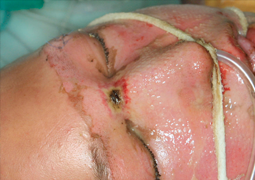
Study group: The authors refer about fifteen years follow-up of pediatric patients at the Department of Burns Medicine, 3rd Medical Faculty, Charles University in Prague, Czech Republic, E.U., with electric discharge injury, in which the anterior uveitis was detected. Out of 43 patients after electric discharge injury, the always-unilateral iritis (iridocyclitis) was diagnosed in four (9 %) patients according to thoroughgoing follow-up after first accidental diagnosis in the year 1998. Out of four boys aged 12 – 15 years, the first two were injured during the “play” - due to the contact with electrical trolley wire while running on railroad wagons’ roofs, and the two others were stuck by lighting under a tree by secondary electrical discharge. More serious skin burns were noticed in high-voltage current injury – 69 % or 55 % of body surface respectively, with the necessity of skin transplantation. The same was necessary in one boy injured by lighting with burns of 25 % of body surface, while the last one had on the skin the lighting signs only. In most of the patients, the resuscitation care due to unconsciousness and posttraumatic shock was necessary. The anterior uveitis was diagnosed subsequently, after initial preliminary diagnoses as conjunctivitis, episcleritis, or ophthalmia electrica. The iritis without visual function decrease was discovered in few days after the injury in three patients.
Treatment and results: The inflammation was in these cases treated with short-term application of mydriatic and corticosteroid eye drops. Once only, the uveitis appeared after two months during the patient’s hospitalization and then the signs of iridocyclitis in the anterior chamber worsened and caused visual acuity decrease to hand movement in front of the eye. The condition was successfully treated by means of parabulbar betamethasone injection and long-term application of mydriatic and corticosteroid drops. Conclusion: Uveitis in electrical discharge injury of different origin is a rare early complication, which may be determined solely by regular ophthalmologic follow-up examinations of the patients.

References

  1. Alexik, M., Štubňa, K., Kačerik, M.: Katarakta po úraze bleskom. Čes a slov Oftal, 67; 2011: 27–29.
  2. Benlier, E., Top, H., Kandulu, H., Yurdakul, E.: Isolated uveitis: a rare complication of electrical injury. J Burn Care Res, 5; 2008: 856.
  3. Cooper, M.A, Price, T.G.: Electrical and lighting injures. Ener Med Clin North Am, 2, 1984: 489–501.
  4. Cooper, M.A.: Emergent care of lighting and electrican injures. Semin. Neuro, 15; 1985: 268–275.
  5. Datta, H., Sarkan, K., Praedeep, R., et al.: An unusual case of late ocular changes after lighting injury. Indian J Ophthalmol, 50; 2002: 224–225.
  6. Duke-Elder, S (ed.).: Text Book of Ophthalmology. Vol. VI. (Injuries), H. Kimptom, London, 1954: 6435–6442.
  7. Fiala, E.: Blesková katarakta. Čs Oftal, 12; 1956: 449–450.
  8. Handa, J.T., Jaffe, G.J.: Lighting maculopathy. Retina, 14; 1994: 164–172.
  9. Izák, M., Koláčný, J., Šváčová, H.: Elektrická katarakta. Čs Oftal, 34; 1978: 145–149.
  10. Jex-Blake, A.J.: The Gulstonian lectures on death from electricity in the late nineteenth century. Med Instrum, 9; 1975: 267.
  11. Klíma, M., Šeba, J., Kindernay, S.: Poranění očí elektrickým výbojem o vysokém napětí. Česk Oftal, 24; 1968: 123–126.
  12. Kobernick, M.: Electrical injuries: pathophysiology and emergency management. Ann. Emerg. Med, 11; 1982: 633.
  13. Königová, R., Bláha, J. a kol.: Komplexní léčba popáleninového traumatu, Karolinum, Praha , 2010 s.432.
  14. Lee, M.S., Gunton, K.B., Fischer, D.H., Brucker, A.J.: Ocular manifestation of remote lighting strike. Retina, 22; 2002: 808–810.
  15. Lin, C.J., Yang, C.H., Yang, C.M., Chang, K.P.: Abnormal electroretinogram and abnormal electrooculogram after lighting-induced ocular injury. Am J Ophthalmol. 133; 2002: 578 – 579.
  16. Miler, B., Goldstein, M., Monshizadeh, R.: Ocular manifestations of electrical injury: a case report and review of the literature. CLAO J, 28; 2002: 224–227.
  17. Navrátil, B.: Cataracta electrica. âs Oftal. 7; 1951: 287–289.
  18. Norman, M.E., Albertsonj, D., Young, B.R.: Ophtalmic manifestations of lighting strike. Survey of Ophtalmol, 46; 2001: 19–24.
  19. Ritenour, A.E., Morton,M.J. et al.: Lighting injury. Burns, 34; 2008: 585–594.
  20. Saffle, J.R., Crandal, A., Warden, G.D.: Cataracts: a long-term complication of electrical injury. J Trauma, 25, 1985: 17 – 21.
  21. Sommer, L.K., Lund-Andersen, H.: Skin burn, bilateral iridocyklitis and amnesia following a lighting injury. Acta Ophtalmol. Scand., 85, 2004: 596–598.
  22. Štefek, J.: Iridocyklitis jako pozdní následek úrazu bleskem. Čs. Oftal, 9; 1953: 301–305.
  23. Těšínský, P., Válová, M.: Uveitida a odchlípení sítnice po zásahu bleskem. Čes. Oftal., 29, 1973: 375–378.
  24. Vrbický, J., Kripner, J., Königová, R. et al.: Úrazy dětí elektrickým proudem. Rozhledy v chirurgii, 64, 1985: 470–474.
  25. Wostrý, M.: Případ očního poranění bleskovým výbojem. Čs Oftal. 3, 1937: 69–71.
  26. Zamarovský, V.: Bohové a hrdinové antických báji. Mladá fronta, Praha, 1965, s. 334–336. the foveolar reflex. Retrospectively it is not impossible to exclude the possibility of accompanying incipient macular oedema, which it was not possible to verify precisely due to the overall condition of the patient. Pathological changes on the level of the RPE, on the basis of indistinct hyperfluorescence in the foveolar area upon FAG examination were recorded by the Slovak authors [1], but a further control examination in this single patient using OCT was without a pathological image. The macular areas are highly sensitive to thermal damage, because here there is a high melanin content. Electrical current may damage the RPE by electrolysis. Macular oedema simulates Berlin’s oedema soon after injury by lightning, in which during the further course it is possible to describe the lesion as a cyst or macular hole, or solar maculopathy [8, 14]. In the last decade, only individual observations of intr