
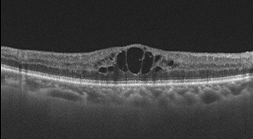


Aims: To evaluate the effectiveness and safety of combined intravitreal steroid and anti-VEGF treatment in patients with retinal vein occlusion at an ophthalmological referral center in Colombia.
Material and Methods: This is an analytical, longitudinal study of patients with macular edema secondary to retinal vein occlusion, who underwent treatment of combined intravitreal steroid and Anti-VEGF therapy at the Ophthalmology Department’s Retina and Vitreous Unit, collected from an anonymized database.
Results: The study included 39 eyes from an anonymized secondary source, from January 2016 to December 2024. After an average follow-up of 18.7 months, a significant improvement in best-corrected visual acuity (from 1.22 to 0.93 LogMAR, p = 0.01) and a statistically significant reduction in central macular thickness (CMT) (from 567.5 to 236 μm, p = 0.01) were observed, with 76.9% of patients achieving a CMT < 300 μm. Intraocular pressure remained stable (15.18 vs. 15.69 mmHg). Most patients received Bevacizumab (64%) and Triamcinolone (66%), and 67% required intravitreal reinjections. The central retinal vein occlusion group showed visual improvement and a decrease in CMT, although 24% experienced complications, mainly elevated intraocular pressure and cataract progression. The superotemporal vein occlusion and inferotemporal vein occlusion groups also showed visual improvement and a reduction in CMT, with few complications.
Conclusion: Combination therapy was effective in improving visual function and reducing macular edema in different types of retinal vein occlusion.